How to Grade a Coin in Hand
A calm, step-by-step workflow for grading a coin yourself: identify it, authenticate it FIRST, check for problems, then judge wear, strike, luster, marks, and eye appeal, and know when to call in a professional.
Last reviewed: · Free to read · Every claim sourced
First, handle the coin safely
In plain English
Hold a raw coin only by its edges, between your thumb and finger, never touch the faces. Skin oils leave fingerprints that permanently mar a coin. Wash your hands first, and work over a soft surface so a dropped coin lands gently.
Going deeper
For high-grade or vintage copper, consider cotton gloves or coin tweezers. Avoid breathing or talking directly over the surfaces. Good, single-point lighting (a desk lamp) and a 5x-10x loupe are the core tools.
Step 1. Identify the coin
In plain English
Work out the type, date, mintmark, denomination, and metal. Sort coins by series, because each series wears in its own way and has its own grading landmarks.
Going deeper
Knowing the exact issue tells you the expected weight, diameter, and composition (useful for authentication) and which high points and weak-strike areas matter for that series.
Sources: American Numismatic Association (ANA)
Evidence pages
Step 2. Authenticate FIRST (before grading)
In plain English
Confirm the coin is genuine before you grade it. A fake has no collector grade. Simple checks: weight and diameter against the known specification, a magnet test where appropriate, and a look at the edge and surfaces for cast seams or tooling.
Going deeper
Professional services authenticate before grading, using weight/diameter, die-diagnostic comparison under magnification, surface/luster analysis, and XRF. For example, a genuine bronze cent is non-magnetic and weighs about 3.11 g, while a plated-steel fake is magnetic and lighter. Cast fakes show edge seams and porosity; struck fakes may show repeating depressions.
Sources: Numismatic Guaranty Company (NGC) · Professional Coin Grading Service (PCGS)
Step 3. Check for problems (cleaning, damage, alteration)
In plain English
Look for cleaning (fine hairlines), scratches, rim dings, corrosion, and added material. A genuine coin with a disqualifying problem gets a 'Details' grade instead of a normal number, and is worth much less.
Going deeper
Tilt the coin under light to reveal hairlines from wiping or harsh cleaning. Environmental damage, PVC residue, whizzing, and tooling all lead to Details/no-grade outcomes. Catching these early prevents mis-grading a problem coin as problem-free.
Sources: Numismatic Guaranty Company (NGC) · Professional Coin Grading Service (PCGS)
Step 4. Circulated or uncirculated?
In plain English
Decide whether the coin shows any wear. No wear at all means Mint State (60-70). Any genuine wear, even a trace, makes it circulated (1-58, with About Uncirculated at 50-58).
Going deeper
Use technical grading for circulated coins (degree and location of wear) and market grading for Mint State (eye appeal weighted). The hardest call is AU-58 vs MS-60: a trace of high-point friction keeps a coin in AU even if it looks lovely.
Sources: Numismatic Guaranty Company (NGC) · American Numismatic Association (ANA)
Step 5. Examine the high points for wear
In plain English
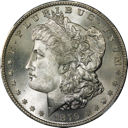
Look at the design's highest points, these wear first. Each series has its landmarks: the bison's horn on a Buffalo nickel, the central bands on a Mercury dime, Liberty's head on a Standing Liberty quarter, the cheek and hair on a Morgan dollar.
Going deeper
Compare the high points to the rest of the design and to verified photo references. Color change on the high points (dull gray on silver, brown on copper) signals wear, not just a soft strike.
Sources: American Numismatic Association (ANA) · Professional Coin Grading Service (PCGS)
Step 6. Judge strike, luster, marks, and eye appeal
In plain English
Evaluate four things separately: strike (how fully the design was stamped), luster (the original mint shine), surface marks (nicks, scratches, hairlines), and overall eye appeal. Remember a weak strike is not wear, it was there from the start.
Going deeper
Professional grading weighs surface, strike, luster, and eye appeal as core elements. On Mint State coins, the number and location of contact marks (worse in focal areas) drive the grade; intact cartwheel luster supports originality; attractive original toning lifts eye appeal.
Sources: Numismatic Guaranty Company (NGC)
Evidence pages
Step 7. Compare, assign a range, then narrow
In plain English
Compare the coin to trusted photo examples for that series, settle on a grade range first (say, 'XF to AU'), then narrow to a single grade using the 1-70 scale.
Going deeper
Use reference sets such as PCGS Photograde and series grading guides. Grading a range first guards against anchoring on one number; narrowing then weighs the marginal factors (a single focal mark, a touch of rub, eye appeal).
Sources: American Numismatic Association (ANA) · Professional Coin Grading Service (PCGS)
Step 8. When to submit to a professional service
In plain English
For Mint State or higher-value coins, professional grading and encapsulation is often worth the fee. At least two expert numismatists examine each coin to authenticate and grade it.
Going deeper
Third-party grading adds a guarantee of authenticity and grade and makes coins easier to buy and sell sight-unseen. Weigh the fee against the coin's value and the risk that a problem (cleaning, doubt about authenticity) limits the outcome.
Sources: American Numismatic Association (ANA) · Numismatic Guaranty Company (NGC)
Key terms in this lesson
Counterfeit · Details Grade · Cleaned · Wear · Weak Strike · Strike · Luster · Contact Marks · Eye Appeal · About Uncirculated (AU) · Mint State · Hairlines