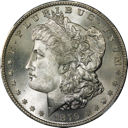
Grading the Morgan Dollar
The Morgan dollar (1878-1921) is a large 90% silver coin and a collector favorite. To grade one, look hard at Liberty's cheek for bag marks (it's a big flat area that shows every nick), and check the hair above the ear and the eagle's breast feathers for wear. New Orleans ('O') coins are often softly struck there, which can look like wear but isn't. Morgans are heavily counterfeited, so authenticate first, especially famous dates like 1893-S, 1889-CC, and 1895.
Last reviewed: · Free to read · Every claim sourced
New to grading? Start with how to grade a coin, step by step, and the Sheldon 1-70 scale.
At a glance
| Years | 1878-1904, 1921 (vintage); modern reissues 2021 and annually since 2023 |
|---|---|
| Designer | George T. Morgan. Vintage Morgans were struck at Philadelphia (no mintmark), New Orleans ('O'), San Francisco ('S'), Carson City ('CC'), and Denver ('D', 1921 only). The mintmark is on the reverse, below the eagle. |
| Denomination | One dollar (silver) |
| Specifications | Vintage: weight 26.73 g (412.5 grains), diameter 38.1 mm. The 2021 reissue is .999 fine silver (~0.858 oz silver) and uses privy marks ('O', 'CC') rather than true mintmarks, since those facilities no longer strike coins. |
Composition over time
| Period | Composition |
|---|---|
| 1878-1921 (vintage) | 90% silver, 10% copper |
| 2021 reissue | .999 fine silver (NOT the vintage 90/10 alloy) |
Major subtypes
| Subtype | Years |
|---|---|
| Vintage Morgan Dollar | 1878-1904, 1921 |
| 2021 Morgan Dollar (100th Anniversary) | 2021 |
Where wear shows first
- Obverse: Liberty's cheek, a large open field that readily shows contact/bag marks (a primary grading area)
- Obverse: the hair above the ear (luster breaks and wear appear here first)
- Reverse: the eagle's breast feathers (high point; wear/flatness shows here first)
Common weak-strike areas
- New Orleans ('O') coins are frequently weakly struck (reduced die pressure / wide die spacing): flat hair around the ear and flat eagle breast feathers, with mushy centers
- Because the hair-over-ear and breast feathers are both high points AND common weak-strike areas, distinguish mint-made softness from actual wear before grading
Strike designations
Prooflike (PL) and Deep Mirror Prooflike (DMPL) are most associated with Morgan dollars. PCGS: PL = clear reflectivity at 2-4 inches; DMPL = clear field reflection at 6+ inches on both sides. NGC uses PL and DPL (Deep Prooflike) and assesses reflectivity qualitatively. (PCGS = DMPL; NGC = DPL.)
Grading circulated coins
Good (G-4): Liberty is a flat silhouette. The hair above the ear and over the forehead is worn smooth into the cheek, and on the reverse the eagle's breast is a featureless plane, though rims, date, and legends remain full. Very Good (VG-8): the hairline around the forehead re-emerges and a few cotton leaves in the cap show; the eagle's wing edges regain some feather outline. Fine (F-12): the hairline is complete from forehead to ear, cotton blossoms are outlined, and roughly half the wing feathering shows, though the breast stays smooth. Very Fine (VF-20): individual strands appear in the hair above the ear, leaves show interior detail, and the eagle's breast begins to show feather texture at its edges. Extremely Fine (EF-40): hair over the ear and forehead is nearly complete with flatness only on the highest strands, and breast feathers are largely defined with wear confined to the high curve. About Uncirculated (AU-50): only a trace of friction dulls the cheek, the hair above the ear, and the eagle's breast; grade by broken luster in those spots, not missing detail. Caveat: New Orleans ('O') dollars are notorious for soft central strikes, so flat hair over the ear and a mushy breast on a fully lustrous coin indicate strike, not wear. If satiny luster flows unbroken across the flat area, the coin is not circulated.
Grading Mint State coins
Mint State Morgans are separated almost entirely by the obverse fields and Liberty's cheek. The big open cheek is the prime focal area, and bag marks there drop a coin from MS-65 to MS-63 faster than anything on the reverse; luster quality (booming cartwheel versus dull satin) and central strike do the rest. Mirror-surfaced coins can also earn the PL or DMPL reflectivity designations described under strike designations above.
Key dates
- 1893-S, the series key: lowest business-strike mintage (100,000) and expensive in every grade, worth four figures even in Good
- 1889-CC, the Carson City key, rare in all grades and extremely rare in Mint State
- 1895, the 'King of the Morgans': a proof-only issue (880 struck) with no business strikes known, so beware altered 1895-O and 1895-S coins
- 1894, the low-mintage (110,972) Philadelphia key, scarce in all grades
- 1903-O, once thought among the rarest in Mint State until the 1962-64 Treasury hoard release, a famous lesson in how population data can change
Semi-key dates
- 1892-S, affordable in circulated grades but a dramatic condition rarity in Mint State
- 1884-S, a similar profile: obtainable in VF, five figures in Mint State
Major varieties
- 1878 8 Tailfeathers, 7 Tailfeathers, and 7-over-8 Tailfeathers, first-year hub changes that are all collected separately
- 1880/79-CC overdate (Reverse of 1878)
- 1888-O 'Hot Lips', a doubled-die obverse with dramatically doubled lips and nose
- 1900-O/CC overmintmark, a popular and affordable New Orleans-over-Carson City variety
- Hundreds of cataloged VAM die varieties; VAM collecting is a specialty built almost entirely on this series
Common problems
- Bag marks on the cheek from mint-bag storage and handling (the open cheek field shows them prominently)
- Cleaning/hairlines and toning (general grading doctrine; mirror-surface PL/DMPL coins highlight hairlines especially)
Counterfeit & alteration risks
- Among the most counterfeited U.S. coins; many modern fakes originate in China and multiple Morgan dates appear on NGC's Top 50 Most Commonly Counterfeited U.S. Coins
- 1893-S (NGC #10): nearly all fakes are an 'S' mintmark added to a no-mintmark Philadelphia coin
- 1889-CC (NGC #43): fakes made by gluing on a 'CC' mintmark or joining a genuine 1889 obverse to a CC reverse
- 1895: the 'King of Morgans'; the 1895 Philadelphia issue is PROOF-ONLY (~880 proofs), so any 'business strike' 1895-P should be treated with extreme suspicion
- General techniques: added/glued mintmarks, joined obverse/reverse halves, altered dates and mintmarks
For the advanced grader
Mint State Morgans are separated largely by the number and severity of marks on the cheek and by luster quality; focal cheek marks hurt the grade more than hidden ones. Read the hair-over-ear and breast feathers carefully and decide whether softness is strike (common on O-mint) or true wear. Prooflike/DMPL (NGC: PL/DPL) coins command premiums but their mirrors magnify hairlines. Given pervasive counterfeiting (added mintmarks, joined halves, altered dates), authenticate before grading and remember the 1895-P is proof-only.
Photographic examples
Click any image to enlarge and zoom. Where shown, obverse, reverse, and edge views are of the same coin and year.
Same coin: 1879-S Morgan dollar, graded NGC MS67+
More dollars to explore
Sources: United States Mint · Professional Coin Grading Service (PCGS) · Numismatic Guaranty Company (NGC) · Coin World
Evidence pages
Related terms
Mint State · Contact Marks · Bag Marks · Luster · Weak Strike · Counterfeit