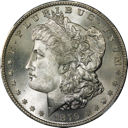
Grading the Liberty Head (V) Nickel
The Liberty Head 'V' nickel (1883–1913), designed by Charles E. Barber, is 75% copper / 25% nickel. The crucial first-year split is 1883 'No CENTS' (just the Roman numeral V, these were gold-plated and passed as $5 gold pieces, the 'Racketeer nickel') versus 1883 'With CENTS' (the word CENTS added to fix the fraud). Grade circulated coins by the word LIBERTY on Liberty's headband: roughly three letters showing is VG, all letters visible (even if weak) is Fine, and all letters sharp is XF. The key date is 1885, followed by 1886 and the 1912-S (the first S-mint nickel). The legendary 1913 Liberty Head nickel (only 5 known) was never an authorized Mint issue, any claimed example must be certified.
Last reviewed: · Free to read · Every claim sourced
New to grading? Start with how to grade a coin, step by step, and the Sheldon 1-70 scale.
At a glance
| Years | 1883–1913 |
|---|---|
| Designer | Charles E. Barber |
| Denomination | Nickels |
| Composition | 75% copper / 25% nickel |
| Diameter | 21.21 mm |
| Weight | 5.00 g |
| Edge | Plain |
| Mints | Philadelphia (no mintmark), 1883–1912, Denver (D), 1912 only (1912-D), San Francisco (S), 1912 only (1912-S, the first S-mint nickel); mintmark on the reverse left of CENTS |
Major subtypes
| Subtype | Years |
|---|---|
| 1883 No CENTS (Type 1) | 1883 only. Roman numeral V with no word CENTS; gold-plated and passed as $5 (the 'Racketeer nickel'). Heavily hoarded, so common today. |
| 1883 With CENTS (Type 2) | 1883–1913, word CENTS added at the bottom; E PLURIBUS UNUM moved above the wreath. The 1883 With CENTS is scarcer than the hoarded No CENTS. |
Where wear shows first
- The word LIBERTY on the headband (obverse), the primary circulated-grade indicator
- Liberty's cheek and the hair above the forehead
- The corn ears / left wreath and the reverse field high points
Other points to check
- The coronet and the stars surrounding the portrait
- The wreath ribbon and the numeral V on the reverse
Common weak-strike areas
- The LIBERTY lettering on the headband (can be soft as struck on some dates)
- The corn/cotton/wheat wreath detail on the reverse
- The high points of Liberty's hair above the forehead
Strike designations
No strike designation (no Full Steps/Full Bands equivalent). 1883 No CENTS vs With CENTS is a design type, not a grading designation. Cameo / Deep (Ultra) Cameo apply to proofs and carry large premiums. The 'Racketeer nickel' is a gold-plated 1883 No CENTS fraud, not a grading or Mint designation.
Grading circulated coins
LIBERTY on the headband is the master gauge. Good (G-4): no full letters of LIBERTY readable. Very Good (VG-8): about three letters of LIBERTY visible. Fine (F-12): all letters of LIBERTY visible though they may be weak. Very Fine: all letters clear with light high-point wear. Extremely Fine (XF/EF): every letter sharp and clear, with only a small flat spot beginning on the cheek under the eye. Always distinguish a weakly struck headband from a worn one.
Grading Mint State coins
No wear interrupts the luster, check the hair above the forehead and the cheek for any smoothing. Liberty nickels generally come well struck with flashy-to-satiny luster. Grade-limiting factors in Mint State are contact marks on the large open obverse field and on the cheek, plus luster quality. Strike is usually strong, so most MS examples show full LIBERTY.
Proof grading
Proofs were struck every year from 1883 through 1912 (both 1883 No CENTS and With CENTS proofs exist). Graded for mirror depth and contrast; Cameo and Deep/Ultra Cameo designations carry large premiums. Distinguish proofs from prooflike business strikes by squared, sharp rims and fully mirrored fields.
Key dates
- 1885 (~1.47M; the key date of the series)
- 1886 (low mintage; second key date)
- 1912-S (~238,000; first San Francisco-mint nickel, lowest-mintage regular issue)
- 1913 Liberty Head nickel (5 known; NOT a regular Mint issue, a clandestine, unauthorized rarity, ~$4.5M in 2018)
Semi-key dates
- 1912-D (first Denver-mint nickel; scarcer than Philadelphia issues)
- 1883 With CENTS (scarcer than the hoarded No CENTS type)
- 1884 (a recognized better date, scarce in higher grades)
Major varieties
- 1883 No CENTS vs With CENTS (the defining first-year type pair)
- Racketeer nickel (1883 No CENTS gold-plated to pass as a $5 gold piece, a contemporary fraud, not a Mint variety)
- 1913 Liberty Head nickel (clandestine, 5 known, not authorized)
Common problems
- Cleaning / whizzing (hairlines, unnatural brightness)
- Contact marks on the open obverse field and cheek
- Altered dates and added mintmarks (especially toward key dates)
- Gold plating on 1883 No CENTS pieces
- Environmental/spotting on the copper-nickel surface
Signs of cleaning or damage
- Hairlines from wiping
- Unnatural brightness or washed-out fields
- Disturbed luster on the cheek and field
- Tool marks around a date digit or mintmark (alteration)
Toning
Copper-nickel Liberty nickels tone to gray, golden, or iridescent hues over original luster; a flat, dull gray surface usually indicates cleaning. Gold coloration on an 1883 No CENTS is a plating (racketeer) red flag, not natural toning.
Counterfeit & alteration risks
- Fake 1913 Liberty Head nickels (most commonly date-altered from another year; only PCGS/NGC/ANACS certification confirms authenticity)
- Added 'S' or 'D' mintmarks on 1912 Philadelphia coins to fake 1912-S / 1912-D (look for tool marks, uneven depth, disturbed field around the letter)
- Gold-plated 1883 No CENTS 'racketeer' nickels (period and modern; the plating is the fraud, the coin is genuine)
- Date alteration to fake 1885/1886; the 1912-S is among the most frequently counterfeited in the series
For the advanced grader
LIBERTY on the headband is the canonical circulated-grade ladder (≈3 letters = VG-8; all letters present though weak = F-12; all sharp = XF), but always separate a softly struck headband from a worn one before assigning a grade. In Mint State the large open obverse field and the cheek are the mark-sensitive zones that cap the grade. The 1883 No CENTS / With CENTS pair is the defining type distinction (No CENTS hoarded and common; With CENTS scarcer). Authentication is paramount: the 1913 (5 known) is unauthorized and heavily faked by date alteration; 1912-S and 1912-D are prime targets for added mintmarks; key 1885/1886 are date-altered. Proofs exist every year 1883–1912 with Cameo/Deep Cameo premiums.
Photographic examples
Click any image to enlarge and zoom. Where shown, obverse, reverse, and edge views are of the same coin and year.
More nickels to explore
Sources: Professional Coin Grading Service (PCGS) · Numismatic Guaranty Company (NGC) · Wikipedia (numismatics articles) · Coin World
Evidence pages
Related terms
Weak Strike · Altered Date · Mintmark · Proof · Cameo (CAM / CA) · Counterfeit